Delta Lake vs Apache Iceberg vs Apache Hudi: How to Choose in 2026
The three table formats now share most features. What still differs: metadata design, engine and catalog support, and write patterns.
TL;DR
- All three turn Parquet files on object storage into ACID tables with time travel, schema evolution and row-level updates. Feature checklists no longer separate them much.
- Delta Lake: a sequential transaction log with checkpoints. Deepest integration with Spark and Databricks; liquid clustering, Change Data Feed, deletion vectors, Unity Catalog.
- Apache Iceberg: a tree of metadata, manifest lists and manifests, with an open REST catalog spec. The broadest multi-engine support; spec v3 adds deletion vectors, row lineage and
VARIANT. - Apache Hudi: a timeline plus record-level indexes. Built for high-volume streaming upserts and incremental pulls.
- Choose by engines that must write, the catalog you'll govern with, and your write pattern. Then use interoperability (UniForm, managed Iceberg, XTable) so the choice isn't a cage.
The problem
NorthBridge's platform runs on Databricks and Delta. In 2026, the finance team bought a warehouse product that reads Iceberg, and the data science team wanted to query the same tables from a Trino cluster. The question on the architecture board: "Should we have picked Iceberg?"
The honest answer was "it depends less than you think", and the useful answer was a short list of questions that decide it.
Key concepts
| Concept | What it means | Why it matters here |
|---|---|---|
| Table format | A spec for the metadata that says which files form a table, at which version | All three are table formats over Parquet |
| Catalog | The service that maps table names to current metadata and controls commits and access | Often matters more than the format |
| Copy-on-write / merge-on-read | Rewrite files on change / record changes separately | All three now support both styles |
| Multi-engine write | Several engines committing safely to the same table | Where formats and catalogs differ most |
| Interoperability layer | Metadata that lets one table be read as another format | Reduces lock-in |
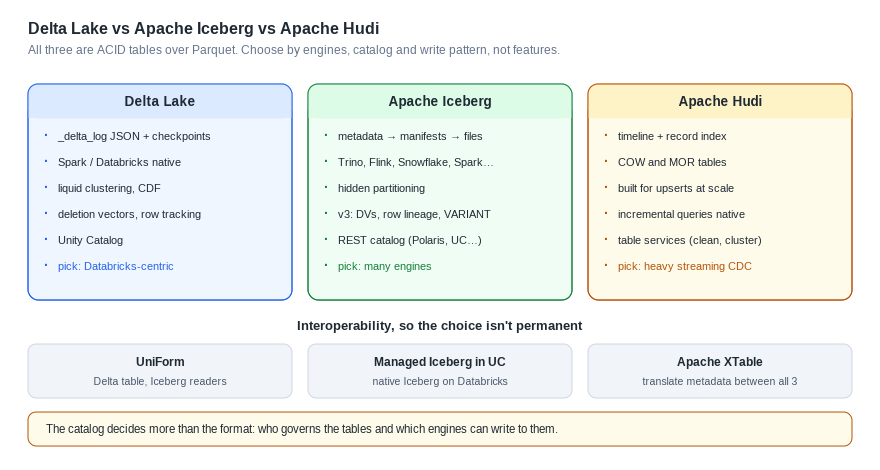 The format is one decision. The catalog is another, and often the bigger one.
How each tracks state
Delta Lake: a sequential log
A _delta_log folder of numbered JSON commits, with periodic Parquet checkpoints. Readers load the latest checkpoint and replay later commits. Writers commit version N+1 atomically. Simple to reason about, easy to inspect, and tightly coupled to Spark's execution model. Details: Inside the Delta Transaction Log.
Apache Iceberg: a metadata tree
Each commit writes a new metadata file pointing to a manifest list, which points to manifests, which list data files with partition and column stats. A catalog holds a pointer to the current metadata file and swaps it atomically. Because the catalog owns the commit, Iceberg was designed from the start for many engines writing through a shared catalog, and the REST catalog spec makes that portable across vendors.
Iceberg's hidden partitioning lets you partition by a transform (days(event_ts), bucket(16, id)) without users needing to know or filter on a derived column, and partition specs can evolve without rewriting data.
Apache Hudi: a timeline with indexes
Hudi records actions on a timeline and maintains indexes (record-level, bloom, secondary) that map keys to file groups. That index is what makes upserts fast: Hudi knows where a key lives without scanning. Tables are copy-on-write or merge-on-read, and table services (compaction, clustering, cleaning) run inline or asynchronously.
Feature comparison (late 2026)
| Delta Lake | Apache Iceberg | Apache Hudi | |
|---|---|---|---|
| ACID, time travel | Yes (versions) | Yes (snapshots) | Yes (commit instants) |
| Row-level deletes | Deletion vectors | Position/equality deletes; deletion vectors in v3 | MOR log files; COW rewrites |
| Row identity / lineage | Row tracking | Row lineage (v3) | Record keys |
| Change feed | Change Data Feed | Incremental reads; row lineage in v3 | Incremental queries, CDC mode |
| Layout | Partitioning, Z-ORDER, liquid clustering | Hidden partitioning, sort orders | Partitioning, clustering service |
| Semi-structured | VARIANT (Delta 4.0+) |
VARIANT (v3) |
Depends on engine |
| Spark | First-class | First-class | First-class |
| Trino, Flink, Snowflake, BigQuery, Athena… | Read widely; write support varies | Broadest read and write support | Narrower, strongest in Spark/Flink |
| Catalogs | Unity Catalog (OSS and Databricks), others | REST catalogs (Polaris, Unity Catalog, Glue, Nessie…) | Hive metastore, Glue, others |
Two convergence points are worth calling out. Iceberg v3's deletion vectors use the same binary encoding as Delta's, and Iceberg v3 row lineage was designed to be compatible with Delta row tracking. The formats are moving towards sharing data files and delete files, differing mainly in metadata.
Decision guide
Ask these in order.
1. Which engines must write to these tables? If only Spark/Databricks writes and other tools only read, Delta is the path of least resistance on Databricks. If several engines (Flink, Trino, Snowflake, Spark) must commit to the same tables, Iceberg with a shared REST catalog is the most proven option.
2. Which catalog will govern them? Permissions, lineage and audit live in the catalog. If you're standardising on Unity Catalog, it manages both Delta and Iceberg tables. If your organisation is standardising on a vendor-neutral REST catalog (Polaris and similar), Iceberg fits naturally.
3. What's the write pattern?
- Mostly batch appends and periodic merges → any of the three.
- Heavy, continuous upserts at very high key cardinality, with incremental pulls downstream → Hudi was built for this; Delta with deletion vectors and clustering, or Iceberg v3 with deletion vectors, are now close for most workloads.
- Heavy CDC propagation on Spark → Delta's Change Data Feed has the longest production track record.
4. What do you already run? Migration has a real cost. A working Delta estate on Databricks rarely benefits from a wholesale move; exposing it to Iceberg readers usually solves the actual problem.
Interoperability: so the choice isn't permanent
UniForm (Delta → Iceberg readers)
-- Databricks Runtime 16.4 LTS+, Unity Catalog
ALTER TABLE northbridge.gold.daily_revenue SET TBLPROPERTIES (
  'delta.enableIcebergCompatV2' = 'true',
  'delta.universalFormat.enabledFormats' = 'iceberg'
);
The table stays Delta; Delta also writes Iceberg metadata so Iceberg clients can read it through Unity Catalog's Iceberg REST endpoint. Constraints: Iceberg v2 compatibility doesn't support deletion vectors, so for DV tables use the Iceberg v3 compatibility mode on runtimes that support it; and Iceberg clients get read access, not write.
Managed Iceberg tables in Unity Catalog
CREATE TABLE northbridge.gold.finance_ledger (...) USING iceberg;Native Iceberg tables, governed and optimised by Databricks, readable and writable by external Iceberg engines through the REST catalog. A good choice for tables another engine must write to.
Apache XTable
An open-source project that translates metadata between Delta, Iceberg and Hudi without copying data. Useful for one-off migrations and mixed estates; check its support for the specific features you use.
What NorthBridge did
- Kept Delta for all Databricks-written tables.
- Enabled UniForm on the 40 gold tables finance needed in its warehouse.
- Created the two tables the finance tool writes to as managed Iceberg tables in Unity Catalog.
- Pointed Trino at Unity Catalog's Iceberg REST endpoint for read access.
No migration, no copies, one set of permissions.
From production: gotchas and lessons
-
Symptom: An external engine read a UniForm table but missed recent changes. Cause: Iceberg metadata generation is asynchronous after Delta commits. Fix: Allow for a short lag, or check the converted metadata version before critical reads.
-
Symptom: Enabling UniForm failed on a heavily updated table. Cause: Iceberg v2 compatibility is incompatible with deletion vectors, which the table used. Fix: Use Iceberg v3 compatibility where supported, or a managed Iceberg table.
-
Symptom: Two engines wrote to the same Iceberg table through different catalogs and corrupted the pointer. Cause: Each catalog thought it owned the table. Fix: One catalog owns each table's commits. Everything else goes through it.
When not to use this
Don't pick a format from a benchmark blog post. Benchmarks depend heavily on engine, version and configuration, and the formats leapfrog each other release to release. Pick on engines, catalog and write pattern, then measure your own workload.
Checklist
- Listed every engine that needs to read and every engine that needs to write
- Chose the governing catalog before the format
- Classified the main write pattern (append, merge, streaming upsert)
- Checked interoperability (UniForm, managed Iceberg, XTable) before planning a migration
- One catalog owns commits for each table
Practice
- Try: Delta Lake Interview Questions: 25 Scenario Problems
- Discuss it: write a one-page recommendation for a company running Databricks for ETL and Snowflake for finance. Which tables would be Delta, UniForm or Iceberg, and why?
Further reading
Keep going
Inside the Delta Transaction Log: Commits, Checkpoints and Optimistic Concurrency
Read _delta_log yourself: what commits and checkpoints contain, how readers build snapshots, and how concurrent writers avoid corruption.
Deletion Vectors and Row Tracking in Delta: What They Change and What They Cost
Deletion vectors mark rows instead of rewriting files; row tracking gives rows stable IDs. How both work, what they cost, and how to purge.
Delta Change Data Feed: CDC Downstream Without Extra Tooling
Enable Change Data Feed and read row-level inserts, updates and deletes by version to refresh downstream Delta tables incrementally.
One practical note a week
Get new articles, problems and guides in your inbox.
Thanks! You're on the list. (Local demo — no email provider is wired up yet.)