DLT, Lakeflow and Spark Declarative Pipelines: The Naming Decoded
Four names, one engine, four years. A short map of what got renamed, what got open-sourced, what your old code still does, and which word to use in an interview.
TL;DR
- Delta Live Tables → Lakeflow Declarative Pipelines → Lakeflow Spark Declarative Pipelines. Same engine, three labels, driven by one open-source donation.
- Lakeflow is the umbrella over three things: Connect (ingest), Spark Declarative Pipelines (transform), and Jobs (orchestrate — what used to be called Workflows).
- Spark Declarative Pipelines (SDP) is the open-source core, contributed to Apache Spark under SPARK-51727 and shipped in Spark 4.1. Databricks runs a superset of it.
- Nothing was deprecated.
import dltstill works. The recommended import is nowfrom pyspark import pipelines as dp. - Bonus rename nobody warned you about: Databricks Asset Bundles are now Declarative Automation Bundles. Same
databricks.yml, same commands.
The problem
You open a six-month-old Stack Overflow answer about Delta Live Tables. You open the Databricks docs, which say Lakeflow Spark Declarative Pipelines. You open a conference talk from last summer that says Lakeflow Declarative Pipelines. A colleague says "SDP" in standup. The Apache Spark release notes say Spark Declarative Pipelines. Your own codebase says import dlt.
Reasonable question: how many products is this?
One. It's one product. But the names changed three times in about eighteen months, each for a defensible reason, and nobody sends out a memo. The confusion is real enough that it costs people interview answers and sends them hunting for migration guides for a migration that doesn't exist.
This article is the map. It's deliberately short, because the actual answer is short — it just isn't written down anywhere in one piece.
Key concepts
| Name you'll see | What it actually refers to | Still correct? |
|---|---|---|
| Delta Live Tables (DLT) | The original 2022 product name | Historical. Understood by everyone, used in docs only as "formerly" |
| Lakeflow | The umbrella family: Connect, Pipelines, Jobs | Yes — but it's a family, not a single thing you use |
| Lakeflow Declarative Pipelines | The transformation framework, 2025 naming | Yes, still widely used |
| Lakeflow Spark Declarative Pipelines | The same framework, current docs naming | Yes — this is what the docs say today |
| Spark Declarative Pipelines (SDP) | The open-source core inside Apache Spark 4.1+ | Yes, and it's the name that will outlive the others |
| Lakeflow Jobs | Orchestration — formerly Databricks Workflows / Jobs | Yes |
| Lakeflow Connect | Managed ingestion connectors | Yes |
| Declarative Automation Bundles | Formerly Databricks Asset Bundles (DABs) | Yes, as of 2026 |
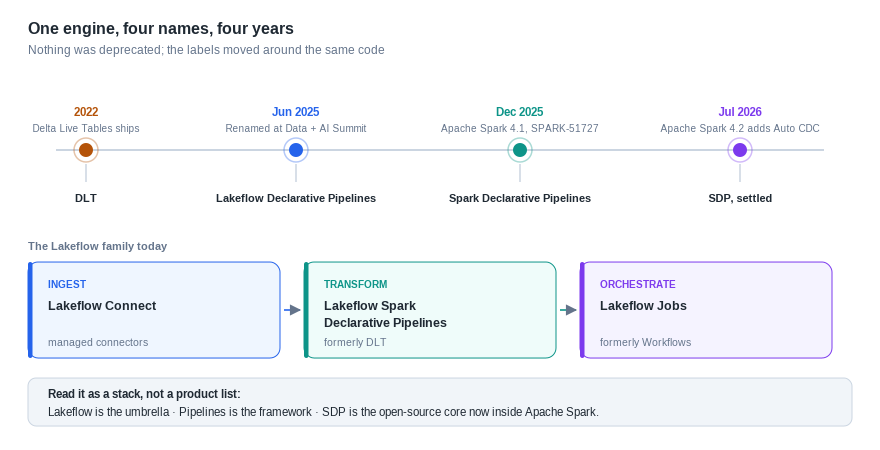 The renames track one real event: the engine stopped being a Databricks-only product and became an Apache Spark feature.
What actually happened, in order
2022 — Delta Live Tables ships
Databricks releases DLT: a declarative framework where you define datasets and quality constraints, and the engine handles execution order, checkpoints, retries and table creation. The API is a Python module called dlt and a set of SQL CREATE STREAMING TABLE statements.
June 2025 — the rename, at Data + AI Summit
Two things happen in the same announcement, and conflating them is the root of most of the confusion.
First, Databricks groups ingestion, transformation and orchestration into one product family called Lakeflow. DLT becomes the transformation pillar and is renamed Lakeflow Declarative Pipelines. Databricks Workflows becomes Lakeflow Jobs. The managed connectors become Lakeflow Connect.
Second — and this is the substantive change, not a marketing one — Databricks announces it is open-sourcing the core declarative ETL engine to Apache Spark. That's why the name needed to change at all: "Delta Live Tables" is a Databricks product name, and you can't donate a product name to the ASF.
December 2025 — Apache Spark 4.1
The donated engine ships in Apache Spark 4.1 as Spark Declarative Pipelines, tracked under umbrella ticket SPARK-51727. Its release note describes it plainly: you define datasets as queries, and Spark handles the execution graph, dependency ordering, parallelism, checkpoints and retries.
This is the part people miss. You can now run declarative pipelines on open-source Spark, with no Databricks account, defining pipelines in YAML composed from Python and SQL files. That's a genuine change in what the thing is, not a label swap.
July 2026 — Apache Spark 4.2
The open-source version keeps moving: Auto CDC for SCD Type 1 arrives (SPARK-56249), along with a SQL CHANGES clause for reading row-level changes (SPARK-55668). The gap between the Databricks implementation and the Apache one narrows with each release, though it hasn't closed.
Today — "Lakeflow Spark Declarative Pipelines"
The current docs title combines both halves: the Databricks implementation (Lakeflow) of the open standard (Spark Declarative Pipelines). Clunky, but precise. It's a framework for building batch and streaming pipelines in SQL and Python that extends and is interoperable with Apache Spark Declarative Pipelines, running on the Databricks Runtime.
How the API maps
This is the table worth bookmarking. Your old code keeps working — the dlt module has been replaced, not removed, and Databricks' position is "you may still use dlt, but we recommend pipelines."
| What it does | DLT syntax | Current syntax | In Apache Spark? |
|---|---|---|---|
| Import | import dlt |
from pyspark import pipelines as dp |
Yes |
| Streaming table | @dlt.table with a streaming DataFrame |
@dp.table |
Yes |
| Materialized view | @dlt.table with a batch DataFrame |
@dp.materialized_view |
Yes |
| View | @dlt.view |
@dp.temporary_view |
Yes |
| Append flow | @dlt.append_flow |
@dp.append_flow |
Yes |
| Update flow | (unavailable) | @dp.update_flow |
No |
| CDC | dlt.apply_changes(...) |
dp.create_auto_cdc_flow(...) |
No |
| Expectations | @dlt.expect(...) |
@dp.expect(...) |
No |
| Sink | @dlt.create_sink(...) |
dp.create_sink(...) |
Yes |
foreachBatch sink |
(unavailable) | @dp.foreach_batch_sink(...) |
No |
| SQL — streaming | CREATE STREAMING TABLE ... |
unchanged | Yes |
| SQL — materialized | CREATE MATERIALIZED VIEW ... |
unchanged | Yes |
Two things in that table deserve more attention than the rest.
@dlt.table split into two decorators. In DLT, @dlt.table meant "streaming table" or "materialized view" depending on whether the DataFrame you returned was streaming or batch. That implicit behaviour is now explicit: @dp.table for streaming tables, @dp.materialized_view for materialized views. This is the single thing that breaks a careless find-and-replace migration, and it breaks it silently — a materialized view turned into a streaming table won't error, it'll just stop updating rows it has already written.
Expectations are not in Apache Spark. Data quality expectations, AUTO CDC and the event log are Databricks-only. If "it's open source now" is part of your architecture argument, know exactly which parts travel and which don't.
What to call it
Practical guidance, because this does come up:
- In an interview: say "Lakeflow Declarative Pipelines, formerly Delta Live Tables" the first time, then whatever you like. Showing you know both names and the relationship between them is the actual signal. Saying only "DLT" in 2026 reads as someone who stopped reading release notes in 2024; saying only "SDP" without the DLT bridge reads as someone who learned it from a blog post yesterday.
- In documentation you write: match the current docs — Lakeflow Spark Declarative Pipelines on first mention, SDP or pipelines thereafter.
- In code:
from pyspark import pipelines as dpfor anything new. - When searching: search for "DLT" when you want blog posts and Stack Overflow answers, and "Lakeflow" or "SDP" when you want current documentation. The older term still has better search coverage for real-world problems — most of the community's accumulated knowledge was written under the old name, and it's all still valid.
The ones that catch people out
-
"Lakeflow" is not one product. People say "we're using Lakeflow" the way they'd say "we're using Airflow," and it isn't comparable. Lakeflow is three products. Ask which pillar they mean — Connect, Pipelines, or Jobs — because the answer changes the conversation entirely.
-
The docs URL changed from
/dlt/to/ldp/. Your bookmarks and internal wiki links mostly redirect, but deep links into specific sections sometimes don't. If an internal runbook has a dead Databricks link, this is usually why. -
Databricks Asset Bundles became Declarative Automation Bundles. In 2026, with CLI v0.287 and above. The file is still
databricks.yml, the commands are stilldatabricks bundle validate / deploy / run, and everyone still says "DABs" out loud. But the docs headings changed, which matters when you're searching for an error message. -
"Spark Declarative Pipelines" sometimes means the open-source thing specifically. Usually the three names are interchangeable in conversation. But when someone is talking about running pipelines without Databricks, they mean the Apache Spark feature specifically, and the feature gaps above become the whole point of the discussion.
-
Nothing was deprecated, and no migration is required. Worth repeating because the volume of "migration playbook" content implies otherwise. Existing DLT pipelines run unchanged. Migrate when you want
@dp.update_floworforeach_batch_sinkor clearer code — not because a heading changed.
When this matters and when it doesn't
It matters when you're searching for help, reading a job description, writing documentation your team will rely on for two years, or arguing about open-source portability in an architecture review.
It does not matter when you're writing a pipeline. The engine doesn't care what you call it. If you understand streaming tables, materialized views, flows and expectations, you understand the product under every one of its names — and the next rename, whenever it comes, will be a half-hour of reading rather than a new skill.
Checklist
- You can say what Lakeflow's three pillars are without looking
- You know
@dlt.tablesplit into@dp.tableand@dp.materialized_view, and why a blanket rename is dangerous - You know expectations and AUTO CDC are Databricks-only, not in Apache Spark
- New code uses
from pyspark import pipelines as dp - Internal docs say "Lakeflow Spark Declarative Pipelines (formerly DLT)" on first mention
- You know "Databricks Asset Bundles" now appears in the docs as "Declarative Automation Bundles"
Practice
- Build it yourself: take any
import dltpipeline you have and port one file — not all of them — to thedpAPI. Pay attention to every@dlt.tableand decide consciously whether it's a streaming table or a materialized view. The ones you have to stop and think about are the ones a find-and-replace would have broken.
Further reading
- Databricks: Lakeflow Spark Declarative Pipelines
- Databricks: Lakeflow pipelines Python language reference
- Apache Spark: SPARK-51727 — Declarative Pipelines
Keep going
Lakeflow Spark Declarative Pipelines (Formerly DLT): Getting Started
Build your first declarative pipeline end to end — streaming tables, materialized views, flows and the pipeline graph — using the pyspark.pipelines API that replaced import dlt.
Lakeflow Connect: Managed Ingestion from Databases and SaaS Sources
What a managed connector actually runs on your behalf — the ingestion gateway, staging and pipeline — plus when a connector beats hand-rolled CDC and when it doesn't.
Lakeflow Jobs: Task Dependencies, Repair Runs and Triggers
Build a job graph that survives a bad night — run_if conditions for error handling, the five trigger types and their limits, and why repair runs only help idempotent tasks.
One practical note a week
Get new articles, problems and guides in your inbox.
Thanks! You're on the list. (Local demo — no email provider is wired up yet.)