Kimball vs Data Vault vs One Big Table: How to Choose
Three modeling styles, three different problems they solve. A decision framework based on source count, audit needs, team size and consumers, plus the hybrid most lakehouses end up with.
TL;DR
- These three aren't rivals for the same job. Data Vault is an integration pattern for many changing sources. Kimball is a presentation pattern for people asking business questions. One Big Table (OBT) is a serving pattern for one specific consumer.
- Few sources, stable systems, BI-heavy users: Kimball alone is enough.
- Many sources, frequent source changes, strict audit or regulatory history: put Data Vault in silver and Kimball on top in gold.
- OBT is great as a derived table for a dashboard or ML feature set. It's a poor choice as your only model.
- The most common mature setup on Databricks is all three, one per layer.
The problem
NorthBridge's data platform lead came back from a conference convinced the company needed Data Vault. A consultant had shown a slide where adding a new source system took a day instead of a month.
Meanwhile the analytics engineers were quietly building wide denormalised tables in dbt, because the BI tool loaded them faster and the sales team liked having every field in one place. And the finance team had spent two years building conformed dimensions in a Kimball model that everyone else kept routing around.
Three groups, three models, one argument that went in circles for a quarter. It went in circles because everyone was answering a different question. The platform lead was worried about integration. The analytics engineers were worried about dashboard speed. Finance was worried about consistent definitions. All three concerns were real.
Key concepts
| Concept | What it means | Why it matters here |
|---|---|---|
| Kimball (dimensional) | Facts and conformed dimensions arranged as star schemas | Optimised for understandable, consistent business queries |
| Data Vault 2.0 | Hubs (business keys), links (relationships) and satellites (descriptive history) | Optimised for adding sources and keeping full, auditable history |
| One Big Table (OBT) | A single wide, denormalised table for a use case | Optimised for one consumer's read speed and simplicity |
| Conformed dimension | One dimension reused across facts with the same keys and meaning | The thing that makes cross-process reporting possible |
| Hash key | A deterministic hash of a business key used as a join key | How Data Vault loads hubs, links and satellites in parallel |
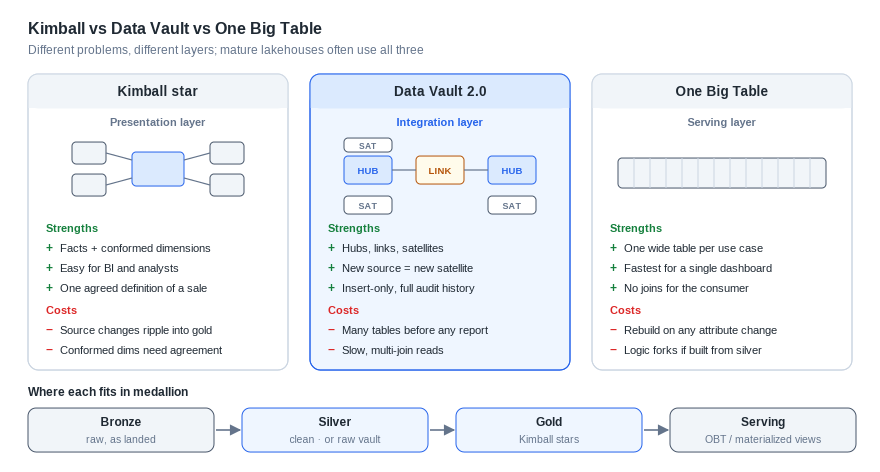 Each style answers a different question. Layered together, they cover all three.
Step-by-step implementation
Step 1 — See what each looks like for the same data
Take one relationship: a customer places an order.
Kimball puts the order lines in fact_sales with a customer_key pointing at dim_customer. Two tables, one join. (Covered in Star Schema in the Lakehouse.)
Data Vault splits it into business keys, relationships and history:
-- Databricks Runtime 16.4 LTS
CREATE TABLE IF NOT EXISTS northbridge.silver.hub_customer (
  hk_customer    STRING    NOT NULL,   -- sha2 of normalised business key
  customer_bk    STRING    NOT NULL,   -- e.g. 'CRM|C-1042'
  load_ts        TIMESTAMP NOT NULL,
  record_source  STRING    NOT NULL
);

CREATE TABLE IF NOT EXISTS northbridge.silver.sat_customer_crm (
  hk_customer    STRING    NOT NULL,
  load_ts        TIMESTAMP NOT NULL,
  hash_diff      STRING    NOT NULL,   -- hash of all descriptive columns
  full_name      STRING,
  city           STRING,
  loyalty_tier   STRING,
  record_source  STRING    NOT NULL
);

CREATE TABLE IF NOT EXISTS northbridge.silver.link_customer_order (
  hk_customer_order STRING NOT NULL,   -- hash of both business keys
  hk_customer    STRING    NOT NULL,
  hk_order       STRING    NOT NULL,
  load_ts        TIMESTAMP NOT NULL,
  record_source  STRING    NOT NULL
);
Hubs and links are insert-only. Satellites are insert-only too: a new row appears whenever hash_diff changes. Nothing is ever updated, which is why Data Vault is so good at audit ("what did the CRM say about this customer on 3 March?") and so tolerant of new sources. A second CRM after an acquisition becomes sat_customer_crm2 hanging off the same hub. No existing table changes.
OBT flattens everything for one purpose:
CREATE OR REPLACE TABLE northbridge.gold.obt_sales_dashboard
CLUSTER BY (order_date, region) AS
SELECT f.order_number, f.line_number, d.calendar_date AS order_date,
       d.fiscal_period, s.store_name, s.region, p.product_name, p.category,
       c.loyalty_tier, c.city AS customer_city_at_sale,
       f.quantity, f.net_amount, f.net_amount - f.cost_amount AS gross_margin
FROM northbridge.gold.fact_sales  f
JOIN northbridge.gold.dim_date     d USING (date_key)
JOIN northbridge.gold.dim_store    s USING (store_key)
JOIN northbridge.gold.dim_product  p USING (product_key)
JOIN northbridge.gold.dim_customer c USING (customer_key);
Look at where the OBT gets its data: from the star. That's the healthy version. An OBT built straight from silver means every business rule lives inside one giant query, and the next OBT reimplements them slightly differently.
Step 2 — Score your situation
| Question | Points toward |
|---|---|
| More than ~10 source systems feeding the same business entities? | Data Vault in silver |
| Sources get added, replaced or restructured several times a year? | Data Vault in silver |
| Regulators or auditors need "what did we know, and when"? | Data Vault (or at minimum, full CDC history in silver) |
| Most consumers are analysts and BI tools? | Kimball in gold |
| Several business processes need to be compared (sales vs inventory vs returns)? | Kimball, with conformed dimensions |
| One dashboard or ML model with strict latency needs? | OBT derived from gold |
| A team of three engineers? | Kimball, possibly OBT. Probably not Data Vault |
That last row matters more than people admit. A Data Vault for a mid-size retailer can easily mean a few hundred tables before a single report exists. Automation tools (dbt packages like datavault4dbt or AutomateDV) make the loading code manageable, but someone still has to understand the model when something breaks at 2 a.m.
Step 3 — Map styles to medallion layers
The pattern that ends most of these arguments:
- Bronze: raw, as landed. No modeling.
- Silver: cleaned and source-aligned. For simple estates, that's just conformed, deduplicated tables. For complex estates, it's the raw vault: hubs, links, satellites.
- Gold: Kimball stars for shared reporting, plus OBTs or materialized views for specific high-traffic consumers.
NorthBridge ended up exactly here. Eleven source systems, two acquisitions in three years and a compliance team that asks for point-in-time customer views justified a vault in silver. Finance's conformed dimensions moved to gold and became the official layer for reporting. The analytics engineers' wide tables survived too, rebuilt as materialized views on the star, so they stopped re-deriving revenue on their own.
From production: gotchas and lessons
-
Symptom: Six months into a Data Vault build, there were 340 tables and no dashboards. Cause: The vault was treated as the deliverable. Nobody built the business layer on top. Fix: Fund the gold layer in the same project. A vault with no star on top is an expensive staging area.
-
Symptom: A 90-column OBT took 40 minutes to rebuild every hour, and storage costs climbed. Cause: A Type 1 change to product category forced a full rewrite, because category was copied onto 800 million rows. Fix: Kept the OBT for the last 13 months only, clustered it on date, and rebuilt it incrementally from the star. The full history stayed in the star, where a category change touches one dimension row.
-
Symptom: Point-in-time queries against the vault were slow and hard to write. Cause: Joining a hub to four satellites "as of" a date means four range joins. Fix: Point-in-time (PIT) and bridge tables, which are the Data Vault's own answer to this. Better still, build the gold dimensions from those PIT tables so analysts never query the vault directly.
-
Symptom: Two dashboards built on two OBTs disagreed on revenue by 2%. Cause: Both OBTs were built from silver with their own join and filter logic. Fix: OBTs only come from gold. That's a rule, not a suggestion.
Performance and cost notes
Columnar storage changed the economics here. Wide tables compress well because repeated strings like category names cost little, so the storage argument against OBT is weaker than it was on row stores. The cost that remains is recompute: every upstream change to a denormalised attribute means rewriting rows. Data Vault moves cost the other way: cheap, parallel, insert-only loads, and expensive multi-join reads. Kimball sits in the middle. That's one more reason the layered approach works: each layer pays the cost it's best at absorbing.
When not to use this
If you have three sources and a handful of analysts, skip the framework debate. Build clean silver tables and a star schema in gold, and revisit this when sources or audit requirements grow. Picking Data Vault "for the future" is a common way to spend a year building infrastructure for problems you don't have yet.
Frequently asked questions
Is Kimball dead in the lakehouse era? No. The cheaper compute changed physical design choices, like less snowflaking and more denormalisation in serving layers. It didn't remove the need for agreed facts, grain and conformed dimensions.
Can Data Vault and Kimball be used together? Yes. That's the most common enterprise pattern: vault for integration, stars for presentation.
Is One Big Table bad practice? Only as the sole model. As a derived serving table, it's often the fastest thing you can give a dashboard.
Checklist
- Source count and rate of source change written down
- Audit and point-in-time requirements confirmed with compliance, not assumed
- Team size and skills considered honestly
- Gold has a star schema with conformed dimensions for shared reporting
- Every OBT is derived from gold and owned by a named consumer
- If Data Vault: PIT/bridge tables planned before the first business request
Practice
- Try: Data Modeling Interview Questions: 20 Design Problems
- Build it yourself: model the same customer and order data three ways (vault, star, OBT). Then add a second CRM source with different customer IDs and count how many existing tables each design has to change.
Further reading
Keep going
Star Schema in the Lakehouse: Facts, Dimensions and Grain
Delta tables didn't make dimensional modeling obsolete. Here's how to pick the grain, split facts from dimensions, and build a star schema on Databricks that analysts can trust.
Surrogate Keys in a Lakehouse: Identity, Hashes or Sequences
Identity columns, hash keys and ROW_NUMBER sequences all produce surrogate keys on Delta Lake. They differ on concurrency, collisions, reproducibility and join cost. Here's how to choose.
Slowly Changing Dimensions: Types 1, 2, 3 and 6 with SQL
One customer moves city. Four SCD types record it four different ways. See the rows each type produces, the SQL that writes them, and how to choose per column.
One practical note a week
Get new articles, problems and guides in your inbox.
Thanks! You're on the list. (Local demo — no email provider is wired up yet.)